
WE HELP AUSTRALIAN BUSINESSES
Run your business smarter with AI + automation.
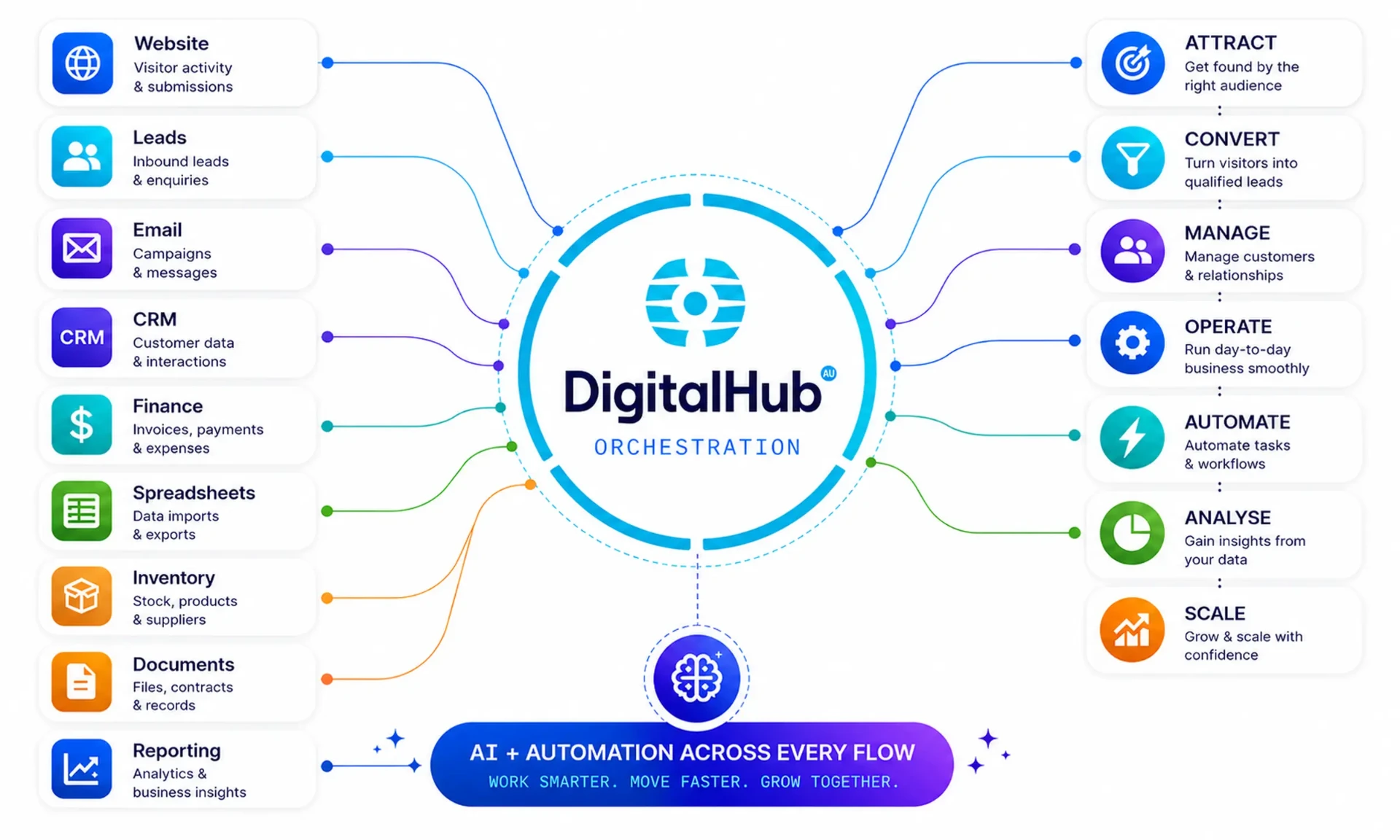
Digital Hub connects your people, data and systems to automate work, streamline operations and drive real business outcomes.
Australian business focus
Designed around real operational problems.
Systems working together
Connect people, data and business processes.
Practical automation
Automate work where it creates genuine value.
Built around your operations
Start with the business problem, not the platform.
Digital Hub is the strategy, architecture and integration layer - not a reseller passing you to a platform.
The same working sequence on every engagement, read left to right: Discover - Design & implement - Integrate - Automate - Optimise.
01
Discover
Understand the operating model before the software.
02
Design & implement
Configure systems around how the work actually runs.
03
Integrate
Connect the systems that already earn their place.
04
Automate
Remove the repetitive steps people should not be doing.
05
Optimise
Keep improving it after go-live, not just at go-live.
01 / Revenue
Leads arrive, but follow-up depends on who is free.
Every enquiry gets the same response, every time.
Enquiries land in different inboxes, get picked up when someone has a spare moment, and go cold. A connected CRM and nurture process makes follow-up a system behaviour rather than a personal habit.

Conceptual state
Lead unassigned - 14 hours
Illustrative example, not real customer data.
Before - how the enquiry travels today
9:02pm
Enquiry lands in a shared inbox
Next day
Someone forwards it on
Later
Nobody is sure who owns it
Better state - the same enquiry, connected
9:02pm
Captured with its source
9:02pm
Owner assigned, clock starts
Ongoing
Nurture runs without chasing
Result
Meeting booked, pipeline current
02 / Productivity
Orders and jobs move through spreadsheets and inboxes.
Work moves through one process everyone can see.
Operational work gets tracked in whatever tool the team had at the time. A connected workflow puts the job, its stage, its owner and its exception in one place - so nothing depends on remembering to forward an email.

Conceptual state
Order ready to invoice
Illustrative example, not real customer data.
Job 4821 - current state
Scheduled • Owner assigned • Ready to invoice on completion
Before: Job tracker v7.xlsx, Forwarded email, Verbal handover, Whiteboard, Duplicate order.
03 / Visibility
Finance sees the result too late to change it.
The numbers arrive while there is still time to act.
When invoicing, cost and delivery live in separate systems, the month-end result is the first honest view. Connecting finance to operations makes margin visible while the work is still in progress.

Conceptual state
Approval required - margin below threshold
Illustrative example, not real customer data.
- Today
- Cost is confirmed after the month closes.
- Connected
- Cost is captured at the point the work happens.
- Today
- Invoicing waits for someone to notice completion.
- Connected
- Completion is the trigger to invoice.
Recognise any of this in your own business?
Opportunity Finder
Where is work getting stuck?
Two quick questions in plain business language. You get a starting point for where change is likely to pay off - no contact details required.
Step 1 of 3
04 / Practical AI
AI gets discussed, but nothing operational changes.
AI does a real task, with a person still in control.
The value is not a chatbot on the website. It is document handling, drafting, classification and summarisation applied inside a process that already exists - with review points where judgement matters.
- SystemA supplier document arrives in the process.
- AIIt is classified and the key fields are drafted.
- PersonA person reviews, corrects and approves.
- SystemThe approved record is written, with an audit trail.

Conceptual state
Document ready for review
Illustrative example, not real customer data.
What changes for the business
Revenue
Fewer enquiries lost between marketing, sales and delivery, and a pipeline leadership can actually read.
Visibility
One version of the numbers, available while decisions are still being made rather than after them.
- Cost
- Less duplicated admin and fewer manual workarounds.
- Productivity
- Repetitive work handled by systems, not people.
- Customer experience
- Consistent response, quoting and service across teams.
- Scale
- Process that holds together as volume and headcount grow.
Choose technology around the business, not the other way around.
We start with the roles the business needs filled. A business may use one platform, several, or systems already in place. Our work is requirements, architecture, implementation, integration and optimisation - the platform is a consequence of that, not the starting point.
Attract & Convert
Capture, nurture, appointments and sales follow-up running as one motion instead of separate tools.
GoHighLevel can fit this role
Manage & Automate
Customer records, service, quoting, projects and workflow held together across the business.
Zoho can fit this role
Operate & Scale
Finance, inventory, procurement, manufacturing and delivery running on shared operational process.
Odoo can fit this role
Explore the work in more detail.
Show us what is slowing the business down.
A consultation is a working conversation about your operating model - not a product demonstration. Bring the part that frustrates you most.